
Hillsborough County Public Schools says it takes professionalism, student welfare, and employee standards seriously.
The question is whether the district applies those standards consistently when complaints are reported, misconduct is documented, and educators are left to deal with the fallout.
That question is at the center of an expanding review by Teaching for the Culture into how HCPS handles complaints, investigations, discipline, transfers, and protections involving educators.
The records reviewed so far do not answer every question. But they do raise serious concerns about accountability, transparency, consistency, and whether the educator who reports harm is always the one the system ultimately protects.
The Jefferson High School Matter
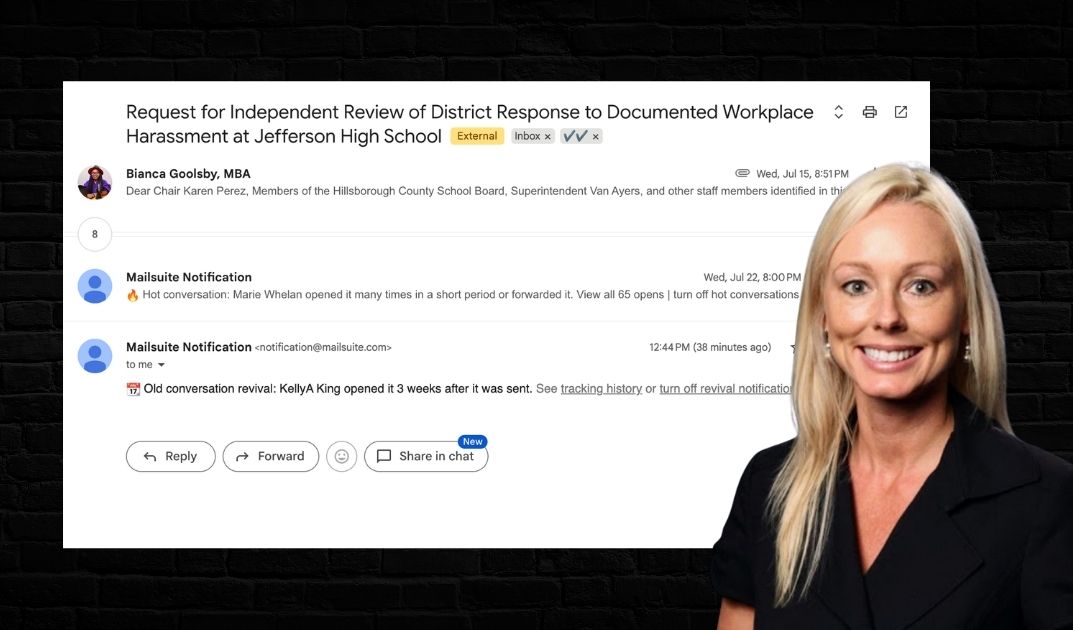
One of the clearest records in this review is a request for an independent examination of the district’s response to a documented workplace harassment matter at Jefferson High School.
In that request, I cited a reprimand involving educator Brittany Cooper. According to the records described in that request, Cooper engaged students in an adult workplace conflict, referred to another educator as a “bitch” in front of students, described that language as a “classroom norm,” asked students to show her an inappropriate image circulating on campus, and encouraged students to weigh in on a dispute between adults.
These are not minor allegations floating around as rumor or gossip. They are findings referenced in a formal request for independent review.
And once those findings are on the table, the next question becomes unavoidable: what meaningful accountability followed?
What Happened to the Reporting Educator?
According to that same review request, the educator who reported harm appeared to experience mediation, placement on paid status, removal from a professional development opportunity, and an eventual transfer.
When the educator reporting harm appears to absorb the disruption, the district should be able to explain how those decisions were made, what standards were used, and whether those standards were applied consistently to everyone involved.
Where Kelly King Appears in the Record
Kelly King, Executive Officer of Professional Standards for HCPS, appears repeatedly in the records reviewed by Teaching for the Culture.
In the correspondence, King acknowledged the reporting educator’s intent to return for the next school year and outlined district procedures involving transfer periods, employment pools, and open hiring. In that same correspondence, the reporting educator raised concerns about blocked access to records, selective adherence to policy, inequitable lapses in procedure, and what was described as punitive consequences.
This May Be Bigger Than One Case
What began as a review of one educator’s case is now raising wider questions.
Since reporting on this matter, Teaching for the Culture has received additional emails from educators connected to other HCPS schools who describe concerns involving complaint handling, inconsistent responses, delays, lack of protection, or disparities in how professional standards matters were addressed.
This is no longer just about one conflict, one school, or one set of personalities. It is about whether a public school district can show that its professional standards process is fair, documented, and consistent when complaints involve real harm, documented misconduct, and unequal professional consequences.
Request for Comment
I contacted Kelly King and left a voicemail requesting comment regarding the district’s handling of Brittany Cooper at Jefferson High School and its process for ensuring consistency across professional standards investigations.
If King or another authorized representative of Hillsborough County Public Schools responds, that response will be included in continuing coverage.
Call for Sources
If you personally reported an incident to Kelly King, the Office of Professional Standards, or another HCPS administrator and believe your complaint was ignored, delayed, dismissed, inconsistently investigated, or handled differently from a comparable case, Teaching for the Culture wants to hear from you.
Confidentiality will be respected and no identifying information will be published without permission.
HCPS cannot keep asking the public for trust while avoiding transparency. If the standards are truly consistent, the records should make that clear.
And if they don’t, that’s a story too.
Editor’s note: The name of the reporting educator has been withheld in this article to protect privacy.
This is an ongoing reporting matter. Additional records, responses, and corroborating accounts are still being reviewed.

Bianca Goolsby, MBA is a digital strategist and activist who partners with mission-driven organizations to increase their impact through innovative and effective online communications. She also empowers and equips families to curate safe social spaces for themselves and their children.